The use of allusion in film grants a filmmaker the ability to create a more focused and deeply inciteful film. That was the mission from Charlie Chaplin in 1936 when he made Modern Times. The film implores many visionary looks to the future of technology and industry while also making strong connections to what the title suggests. They make abundant parallels to the “Modern Times” in the early 1900s and the difficult living situation that many people face at the time. Making connections to the job market, criminal activity, and workers unionization.
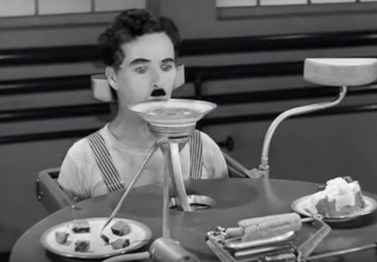
One of the things that Modern Times does immensely well is its use of commentary. Chaplin focuses mainly on the commentary of modern lifestyle but some of its commentaries is seemingly creating a slight allusion to the future use of technology and our over-dependence on it. The film’s most famous sequence being the “Self-Feeding Machine” is itself a commentary on both technological dependence and working conditions at the time. It makes a commentary on the future of how society acts as an industry that was creating more appliances to make life easier. In the coming decades, it became a popular trend to add more appliances to your house to create a more complete living space. The additions that were within the next thirty years of the technological breakthrough were items such as the refrigerator, freezer, and vacuum to name a few. The way that Modern Times makes commentary on this resides in its look at the way business looks at a potential profit in the situation. The introduction of the “Self-Feeding Machine” marks a time when the company in the film is looking for a way to maintain focus on the production line. Showing the limited time workers generally get to rest and take some time away from the bench. The machine is used to keep the workers at their stations instead of allowing them breaks away from their positions. The comedy arises when the machine malfunctions and doesn’t work as intended, leading to sequences where food is then spilled onto Chaplin’s Tramp character. Nevertheless, the scene leaves a message showing some parallels to some other films have also explored. Fritz Lang’s 1927 sci-fi classic Metropolis also explored the parallels between the working class and upper class similar to the dynamic shown between the workers and the bosses in Modern Times. Metropolis is also regarded as a film that makes strong assertions toward a potential future with technology at the forefront of the industry, similar to the way that Modern Times shows us the potential for technology to make its stranglehold on our lives and our industry.
To make another connection to Metropolis. The very opening shot of Modern Times is a brief shot of a pack of sheep, seemingly being funneled into a tunnel. The shot fades out and we are brought back into the film with a shot of a large crowd of workers, creating a seamless edit of these two sequences. This is Chaplin commentating on the apparent notion of sheep being lured to the slaughter. In the case of the workers, it is alluded to that they themselves are being worked to death in the factories with deplorable conditions. This sequence is Chaplin blending the notion of allusion and commentary. I bring up Metropolis again due to its obvious comparisons to its famous sequence of workers marching along a tunnel going to work. While on the other side of the tunnel there is a matching group of workings leaving the same job. Creating an allegory for the mundane and methodical working pace of people caught in the lower end of society in this post-depression era of living in North-America.
Working off that idea of post-depression lifestyle, Chaplin loves to make allusion to that way of living with every passing scene. After The Tramp gets fired from his position at the factory, he is sent to jail. The Great Depression is known for the decrease in job opportunities and mass-exodus of even low paying positions at factories. This leads to a sequence when The Tramp meets his love interest in the film. The young woman proceeds to steal a loaf of bread and runs into The Tramp. The Tramp at this point is just getting released from jail. Once the police catch up, The Tramp lies to the officer and makes a claim that he was the theft and not the young woman. This is an ideology at the time that you can see represented in the film. Where those who have no hope to find work would much rather be locked up in jail instead of being on the streets with the threat of being potentially harmed in the seedy environment of a failing cityscape. Due to the idea that prisons could be safer for these individuals rather than being homeless. This is the state of mind someone living in this era would be struggling with. The lack of work, little to no income and many of these individuals are family driven. Some could potentially lose hope and break the law intentionally in order to be free of the empty, purposeless life they may have. Chaplin is making this connection seeing as this movie is only four years removed from Franklin D. Roosevelt signing of The New Deal, which allowed the United States further economic security in the following years. Chaplin shows this ideology of living because of how soon removed the U.S. is from this post-depression lifestyle and wants to acknowledge that way of living will not be forgotten as the years go on and the economy stabilizes with the impending market increase.
A scene that follows, later on, is a sequence of when The Tramp and his dame are looking yearningly at a man leaving for work as his wife says goodbye. The family appears to be living in a more upscale and modern house. At the time, it would have been difficult for families to afford houses such as those unless they come from or have accumulated decent wealth before the market collapse. The Tramp dreams of a life he could share with his partner, living in an upscale living area, wearing new clothes and having a sustainable life. To cope with said fantasy, they go to a department store and pretend to live as upscale individuals. Wearing the clothes, playing with the toys and laying in the store’s beds. This is a way that Chaplin is making connections to the lifestyle that was unattainable for people at the time. However, in reality, the situation could be much darker. At the time it was common for major metropolitan areas to be ravaged by gangs and mobsters who would frequently steal valuable goods in order to make money off of the lower class by selling them these goods for cheap. The United States had been a victim of this type of illegal activity during the age of prohibition of Alcohol. Where mobsters would funnel liquor through underground dealing and circumvent the law in order to make profits on citizens. Again, adding to the social commentary and allusion to the “modern times” in the universe of the movie. To further the point on the post-depression lifestyle we can look back to one of the initial scenes with The Tramp’s love interest prior to her meeting him. We see a scene in which the love interest in collecting wood from the dock with a few other women. We flash quickly to a crowd of workers protesting the lack of jobs. We then hear gunshots. We watch as our leading lady rushes to the commotion to notice that her father has been shot and killed by either an officer or another angry protester. The scene transitions with a title card stating that “The Law will take charge of the orphans.”. Referring to the younger members of the family. The officers proceed to take them away as the scene progresses back to their house. Presumably taking them to an orphanage as our main female lead escapes law enforcement. This could happen during the depression era. When families are no longer able to afford kids or if a member dies and there are no feasible means to find a guardian through genetics. The government would step in and bring the children into their custody. Giving them the opportunity to be adopted by a suitable family. I refer to a famous photo that first made its appearance in The Vidette-Messenger, in Valparaiso, Indiana in 1948.[1]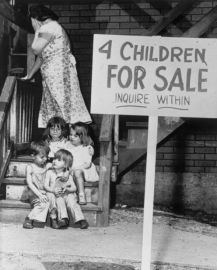 depicts a mother being forced to sell her own children at a time of economic depression. Despite it not coming in the form of the 1920s through 30s depression. The economic situation in post-WWII America was scathing to many families. This is another way that Chaplin makes these connections to modern subjects and sentiments at the time of nationwide capitalistic downfall.
One of Chaplin’s focuses are the workers and the environments that they are forced to work in. He makes points for this by highlighting the machinery multiple times in the film. He passes all of the said sequences off as comedic but does sit in a legitimate, realistic scenario. The famous sequence of The Tramp being carried through the gears of the conveyor machine is passed as comedic but remains a constant threat in such a workplace. As well as the sequence close to the end of the second act where The Tramp’s supervisor falls into the machine and gears and is saved multiple times by The Tramp. The way Chaplin directs the scene tells the audience it’s a comedic moment. Due to the light-hearted music, over-the-top reactions and slapstick used by The Tramp in the lead-up. Marking a statement on the lack of safety in these high-powered machines in potentially unsafe working environments. One of the main issues that the film likes to take a look at is the abundance of protests and strikes from workers. The protest could be ranging from striking against the oppressive industry or protesting the lack of available jobs. The prospect of protesting was nothing new at the time of making Modern Times. However, there are a few major movements that set the stage as precursors to the movements depicted in the film. One of the most talked about major strikes was set in Winnipeg, Manitoba in 1919. After witnessing a successful mass strike during the 1917 Russian Revolution, thousands of workers in Manitoba took to the streets to protest the lack of “essential services”.[2] Such as safer working conditions and better wages. This strike is one of the major moments in North-American union rights. This strike is certainly an influence on many of the issues raised at the time of the depression and post-depression culture in the United States and is highlighted as an allegory in Modern Times.
The final observation to make about the film references Lúcia Nagib’s work on creating a definition of World Cinema. When Nagib makes a statement of how western audiences focus on “World Cinema as non-Hollywood cinema”[3]. The film as a whole is a very western-centric film with western ideas. The film’s focus on American political and industry satire is inherently the work of Chaplin to keep his focus direct and to the point of American ideals and not those of a worldwide idea of technological and social allegory and allusion.
As a final thought. Modern Times is a cultural classic, and not just for its outlandish and revolutionary comedic gags and bits. It is a deep-rooted cultural conversation about the worlds overdependence on technology in the workplace and its stranglehold on American society. While also giving light to the societal issues people faced in the aftermath of The Great Depression. Issues such as poor living and working conditions, pro-worker movements, the abundance of criminal activity and the lack of employment for individuals below the poverty line. Allusion is a powerful tool to create a deeper meaning in a piece of art and can be found in even the most comedic places.
[1]4 Children for Sale, Inquire Inside.August 4th, 1948. Rare Historical Photos. Indiana: The Vidette-Messenger, 1948.
[2]Reilly, J. Nolan. “Winnipeg General Strike”. The Canadian Encyclopedia
https://www.thecanadianencyclopedia.ca/en/article/winnipeg-general-strike
[3]Lucia Nagib, Towards a Positive Definition of World Cinema (London & New York: Wallflower Press), 30, para. 2.

 The FilmSpot